How to import frozen açaí pulp from Brazil: Incoterms, documents, cold chain and lead times

Short answer
To import frozen açaí pulp from Brazil, you need a commercial invoice, packing list, bill of lading and a COA per production lot, plus destination-specific documents such as FDA Prior Notice (US), an e-COI in TRACES (EU, for organic) or an organic certificate in the IID (Canada). Tribo ships FOB Vila do Conde (Pará) as standard, at -18°C in a reefer container, with a minimum order of 1 pallet and made-to-order production in 15 business days.
Importing frozen açaí pulp from Brazil comes down to three decisions you need to make before the first shipment: which documents your country requires, which Incoterm sets where the supplier’s responsibility ends, and how the product stays at -18°C from the factory to your warehouse. This guide answers all three, with a step-by-step first order and what to expect on lead times.
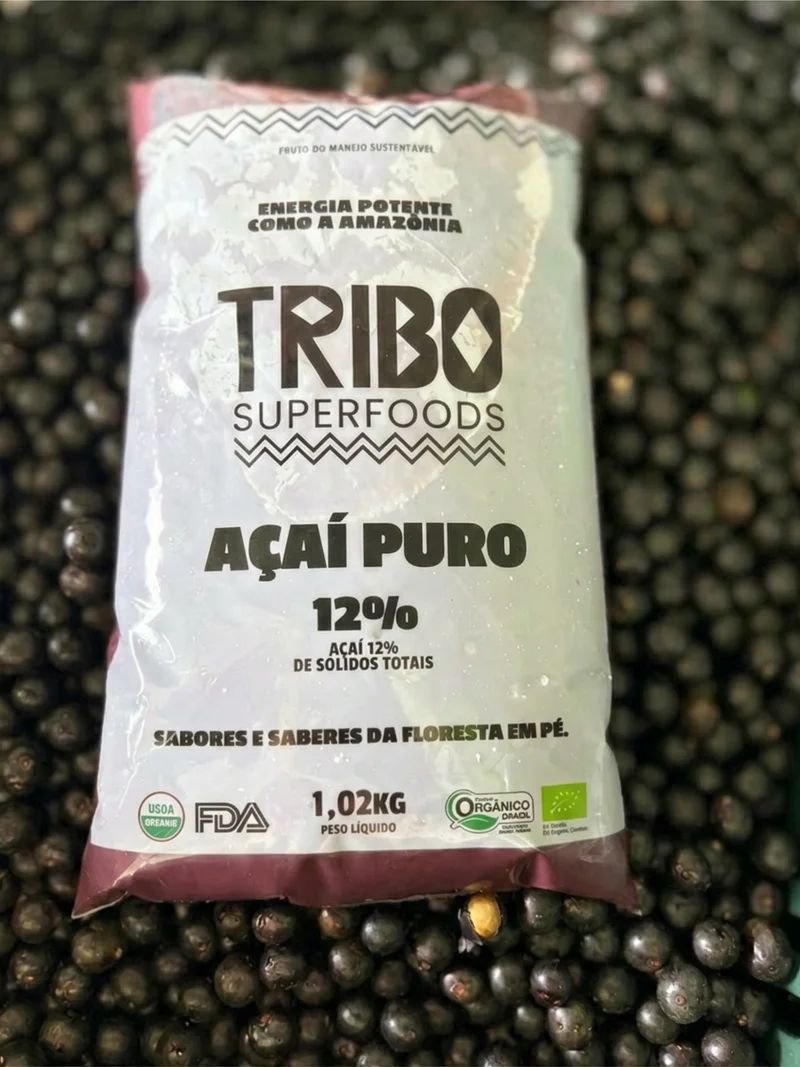
At Tribo, the standard export term is FOB Vila do Conde (Barcarena, Pará), and we also work with CIF and other Incoterms, agreed during negotiation. The minimum order is 1 pallet (1,000 to 1,200 kg depending on the SKU), so you can trial the product on your line without committing to a full container from day one.
Which documents travel with a shipment of frozen açaí pulp?
There is a core set that applies to every destination, plus country-specific requirements. The rule of thumb: the exporter handles the paperwork to leave Brazil, and you, the importer, handle customs clearance at destination. On the Brazilian side, the export is filed by the exporter (or its legal representative) as a single export declaration (DU-E) in the Siscomex system [1], so there is nothing for you to file there.
Core documents for every shipment
| Document | What it does for you |
|---|---|
| Commercial invoice | Basis for customs value and payment |
| Packing list | Lets you check pallets, cartons, lots and weights on receipt |
| Bill of lading (B/L) | Proof of shipment and the document you need to collect the cargo at port |
| Certificate of origin | May be required by your country or to claim a tariff preference; check with your customs broker |
| COA (certificate of analysis) | Microbiological and physicochemical results issued per production lot, so your QC team can release the cargo |
| Organic and Halal certificates | Back up the claims on your product label: Organic Brazil, EU Organic, USDA Organic, Canada Organic and Halal (FAMBRAS Halal) |
The COAs are issued by the Multi-Analysis Laboratory of the Federal University of Pará (UFPA). For supplier audits, Tribo also provides documentation of its implemented HACCP protocol; organic and chain-of-custody certification is by QIMA IBD.
United States: facility registration, Prior Notice and FSVP
- FDA facility registration. Facilities that manufacture, process, pack or hold food for consumption in the US must register with the FDA and renew every two years [2]. Tribo operates an FDA-registered facility. Registration is not a certification or an approval of the product.
- Prior Notice. All imported food requires advance notice to the FDA before it arrives in the US, submitted through the Prior Notice System Interface (PNSI) [3]. For ocean freight, notice must be submitted at least 8 hours before arrival at port, and no more than 15 days in advance through PNSI or 30 days through the ABI/ACE customs system [4]. Agree with your customs broker who will file it.
- FSVP. As the US importer, you are responsible for the Foreign Supplier Verification Program: analyzing hazards and supplier performance, approving suppliers and carrying out verification activities such as audits, sampling and review of food safety records [5]. A COA per lot and HACCP documentation feed directly into your FSVP.
European Union: e-COI in TRACES for organic product
Every product imported into the EU as organic needs an electronic certificate of inspection (e-COI) issued in the TRACES system; without it, the shipment is not released at the port of arrival [6]. The rules come from Regulation (EU) 2018/848 and Regulation (EU) 2021/2306. The COI is issued by the control body in the exporting country before the cargo leaves, and the first consignee confirms receipt in box 31 of the certificate in TRACES [7]. For Tribo, organic certification and e-COI issuance are handled by QIMA IBD.
Canada: organic certificate in the IID
To sell with an organic claim in Canada, the importer or its customs broker must attach the product’s organic certificate to the Integrated Import Declaration (IID), or quote the reference number (URN) generated at the first submission; without it, the shipment may be refused [8]. The certificate must be issued by an accredited body, for the last operation that handled the product before export, and be valid at the time of import [8].
Requirements change often. Before shipping to any new destination, confirm the full list with your customs broker or the local food authority.
FOB, CIF or another Incoterm: what changes for the buyer?
The International Chamber of Commerce’s (ICC) Incoterms 2020 are eleven three-letter rules that allocate tasks, costs and risks between seller and buyer [9]. For açaí pulp shipped by sea, the most common are FOB, CFR and CIF. Under all three, risk passes to the buyer once the goods are on board the vessel at the port of shipment [10].
| Item | FOB Vila do Conde | CFR (destination port) | CIF (destination port) |
|---|---|---|---|
| Export clearance | Seller | Seller | Seller |
| Ocean freight contract and payment | Buyer | Seller | Seller |
| Cargo insurance | Neither party obliged | Neither party obliged | Seller, minimum cover (Institute Cargo Clauses C) |
| Where risk passes to the buyer | On board the vessel, port of shipment | On board the vessel, port of shipment | On board the vessel, port of shipment |
| Import clearance | Buyer | Buyer | Buyer |
Source: ICC, Incoterms 2020 [10].
What this means in practice:
- FOB gives you control over the shipping line, routing and insurance. It is the better fit if you already have reefer freight contracts or a trusted freight forwarder.
- CIF simplifies purchasing, but the minimum insurance required is limited. The ICC itself notes that the parties can agree on broader cover [10]. For frozen cargo, check whether the policy covers reefer breakdown.
- Containers. The ICC warns that FOB is not the appropriate rule when goods are handed to the carrier at a container terminal, in which case FCA should be considered; for the same reason, it points to CIP rather than CIF [10]. Raise this with Tribo and your customs broker during negotiation.
How does the -18°C cold chain work from port to your warehouse?
The pulp is stored and transported at -18°C, and its 24-month shelf life from manufacture depends on keeping it at or below that temperature. Any break in the cold chain cuts into the shelf life you will have in stock.
The route has four links:
- Factory cold storage in Igarapé-Miri, where the lot stays until shipment.
- Stuffing at the factory. The reefer container comes to the factory and is loaded there, with the pulp already frozen and the setpoint at -18°C. The cargo does not change equipment on the way to port.
- Port of Vila do Conde, in Barcarena, where the container goes on board.
- Destination leg, from port to your warehouse. In the US, road or rail transport after arrival falls under the FDA Sanitary Transportation rule, which requires vehicles able to maintain the necessary temperature and adequate temperature controls during the operation; the ocean leg is not covered by the rule [11].
On receipt, we recommend your team checks the container temperature reading and the reefer log before unloading, and confirms that the lot number on the cartons matches the COA. Ocean transit time varies a lot by destination and the carrier’s route; it is quoted together with the freight.
Minimum order, made-to-order production and lead times: how does a first order work?
The pulp is made to order, which means your lot leaves the factory freshly produced, with most of its 24-month shelf life available for your planning. Here is the step-by-step:
- Contact and specification. Tell us the SKU (Açaí Pulp 8%, 12% or 14% total solids), volume, destination, preferred Incoterm and the certifications you need. Our sales team replies within 24 hours.
- Sample and supplier approval. You receive a sample with the lot COA, the technical data sheet and the certificates for your supplier approval process (see the next section).
- Proposal and Incoterm. We agree on commercial terms, the Incoterm and the documents your country requires.
- Order confirmation. The minimum is 1 pallet, 1,000 to 1,200 kg depending on the SKU.
- Production. 15 business days, made to order. The COA is issued per production lot.
- Documents and shipment. Invoice, packing list, certificates and the Brazilian export declaration are issued; the reefer container is stuffed at the factory at -18°C and shipped from Vila do Conde. Book reefer space as early as possible: equipment and vessel availability is what most often sets the shipping date.
- Transit and clearance. Your customs broker handles the import (for example, Prior Notice in the US or e-COI validation in the EU).
Recurring volume. In harvest season, capacity is up to 120 t/month per SKU, so a bulk açaí pulp importer can scale from a first pallet to regular container loads with the same supplier. For volumes above 60 t/month, we recommend signing a supply contract at least 60 days in advance, which gives you priority in volume allocation. See the specifications for each SKU on our products page.
How do I request a sample before the first order?
Request a sample through our contact form, stating:
- the SKU or SKUs you want to evaluate and the application (ice cream, beverage, bowl, formulation);
- the country and city where the sample should be delivered;
- the certifications and documents your quality team will require for supplier approval.
We ship samples of each SKU with the COA for the corresponding lot, and our sales team replies within 24 hours with logistics and availability. If you are comparing options to import acai pulp from Brazil, samples ship by air from Guarulhos (São Paulo), with sample freight paid by the customer.
To get the technical data sheet, certificates and supplier approval documents in one place, visit our page for industrial buyers.
Frequently asked questions
What is the minimum order to import açaí pulp from Tribo?
The minimum order is 1 pallet, 1,000 to 1,200 kg depending on the SKU, for the 8%, 12% and 14% pulps. Production is made to order, with a lead time of 15 business days after order confirmation.
Do you sell CIF, or only FOB?
Our standard export term is FOB Vila do Conde (Barcarena, Pará), but we work with FOB, CIF and other Incoterms. The term is agreed during negotiation, based on volume, destination and order frequency.
Does Tribo file the FDA Prior Notice?
Prior Notice is an advance notification to the FDA submitted before the shipment arrives in the US, and whoever submits it needs the shipment details. Agree with your customs broker who will file it; Tribo provides the shipment data and the details of its FDA-registered facility.
Does every lot come with a certificate of analysis?
Yes. The COA, covering microbiological and physicochemical testing, is issued per production lot and travels with the shipping documents. Your quality team can release the shipment lot by lot.
What is the shelf life of the frozen pulp once it reaches my warehouse?
Shelf life is 24 months from manufacture, provided the pulp is kept at -18°C or below. That gives you room to plan inventory and consumption between shipments.
Can I get a sample before placing the first order?
Yes. We ship samples of each SKU with the COA for the corresponding lot. Request one through our contact form and our sales team replies within 24 hours. Samples ship by air from Guarulhos (São Paulo), with sample freight paid by the customer.
References
- Declarar exportação, retificar e consultar (Export declaration: file, amend and check). Receita Federal do Brasil (Brazilian Federal Revenue Service) — gov.br. Available at:gov.br. AccessedOctober 29, 2026.
- Registration of Food Facilities and Other Submissions. U.S. Food and Drug Administration (FDA). Available at:fda.gov. AccessedOctober 29, 2026.
- Prior Notice of Imported Foods. U.S. Food and Drug Administration (FDA). Available at:fda.gov. AccessedOctober 29, 2026.
- 21 CFR § 1.279 — When must prior notice be submitted to FDA?. Code of Federal Regulations (US), via Legal Information Institute, Cornell Law School. Available at:law.cornell.edu. AccessedOctober 29, 2026.
- FSMA Final Rule on Foreign Supplier Verification Programs (FSVP) for Importers of Food for Humans and Animals. U.S. Food and Drug Administration (FDA). Available at:fda.gov. AccessedOctober 29, 2026.
- Trade in organics. European Commission — Agriculture and Rural Development. Available at:agriculture.ec.europa.eu. AccessedOctober 29, 2026.
- Import of organic products into Austria. Bundesamt für Verbrauchergesundheit (BAVG), Austria. Available at:bavg.gv.at. AccessedOctober 29, 2026.
- Canada Organic Regime import requirements. Canadian Food Inspection Agency (CFIA). Available at:inspection.canada.ca. AccessedOctober 29, 2026.
- Incoterms® 2020. International Chamber of Commerce (ICC). Available at:iccwbo.org. AccessedOctober 29, 2026.
- International Chamber of Commerce (ICC). Incoterms® 2020 — Rules for sea and inland waterway transport (FAS, FOB, CFR, CIF). ICC Digital Library. 2019. Available at:library.iccwbo.org. AccessedOctober 29, 2026.
- FSMA Final Rule on Sanitary Transportation of Human and Animal Food. U.S. Food and Drug Administration (FDA). Available at:fda.gov. AccessedOctober 29, 2026.